
Why Retire Wealth Planning Starts Now (And How to Begin)

“Every day you don’t have a retirement wealth plan, compound interest is working for someone else.“
You’re 58, still working hard, and retirement is no longer some distant dream. Maybe you have a decent 401(k) balance, or maybe you’re staring at a low savings account after kids, college bills, or a few unexpected life hits. Either way, the thought of “starting now” can feel overwhelming—or pointless if you believe you’re already behind.
Here’s the truth: retire wealth planning starts now, and it does not require perfection. This is not another scare-tactic article that leaves you feeling anxious. It is a practical roadmap that shows exactly why acting today beats waiting for the “right time.”
The Cost of Waiting Is Not What You Think
Most people assume the biggest penalty for delaying retirement planning is simply “having less money later.” The real cost runs deeper—and the math makes it crystal clear.
Start with the Rule of 72. Divide 72 by your expected annual return, and you learn how many years it takes for your money to double. At a realistic 7% average return, your money doubles roughly every 10 years. Wait five years to start, and you miss half a doubling cycle. That gap compounds into real dollars.
Take Monica, a 42-year-old office manager who begins investing $500 a month today. Her colleague Dave waits five years and then invests the same $500 monthly. By age 65, Monica’s account holds about $341,000 while Dave’s sits at roughly $215,000. Monica ends up with $126,000 more—without ever contributing an extra dime.

The hidden cost goes beyond dollars. Delayed planning also steals peace of mind. You carry low-level worry into work meetings, family dinners, and doctor visits. That stress quietly affects your health, your relationships, and even your job performance.
Pro Tip: Use the free compound interest calculator at investor.gov right now. Plug in your current age, a modest $300 monthly contribution, and a 7% average return. The number you see will motivate you more than anything else in this article.
Here is what that monthly $400 investment at a 7% average annual return looks like by age 65, depending on when you start:
| Start Age | Years Invested | Total Contributed | Final Balance |
|---|---|---|---|
| 35 | 30 | $144,000 | $488,000 |
| 40 | 25 | $120,000 | $324,000 |
| 45 | 20 | $96,000 | $208,000 |
| 50 | 15 | $72,000 | $127,000 |
| 55 | 10 | $48,000 | $69,000 |
Source: Compound interest projections at 7% average annual return. For illustrative purposes only.
Bottom line: Every year you wait does not just cost you money—it costs you options.
What “Retire Wealth Planning” Actually Means
Many people avoid planning because they picture complicated spreadsheets, high-pressure brokers, and endless jargon. Retire wealth planning is far simpler. It is a straightforward system built on three pillars that work together: Accumulate, Protect, and Distribute.
Most folks only focus on the first pillar—putting money away. The real power comes when you deliberately address all three.
The Three Pillars Explained Simply
Accumulate means steadily building your asset base through accounts such as 401(k)s, IRAs, brokerage accounts, and home equity.
Protect means shielding what you build from taxes, inflation, and market swings. Think tax diversification (Roth versus traditional accounts), proper insurance, and a solid emergency reserve.
Distribute means turning your savings into income you cannot outlive. This includes smart Social Security timing and a withdrawal strategy that keeps your portfolio healthy for decades.
How Much Do You Actually Need?
A quick starting point is the 4% rule. Take your estimated annual retirement expenses and divide by 0.04. That gives you a rough target nest egg.
If you spend $4,000 a month ($48,000 a year), your target is about $1.2 million. This is an estimate, not a verdict. Your actual number depends on your lifestyle, health, pension, and when you plan to retire. The beauty is that the number is adjustable—and you control the levers.
Common Mistake: Thinking “I’ll figure out the retirement number later.” Not knowing your target is like driving to an unknown destination—you might end up somewhere, but probably not where you wanted.
Why Right Now Is Actually the Best Moment in History to Start
It is easy to feel the economy is too uncertain or that you have missed the boat. In reality, 2026 offers several genuine tailwinds for anyone ready to begin retire wealth planning.
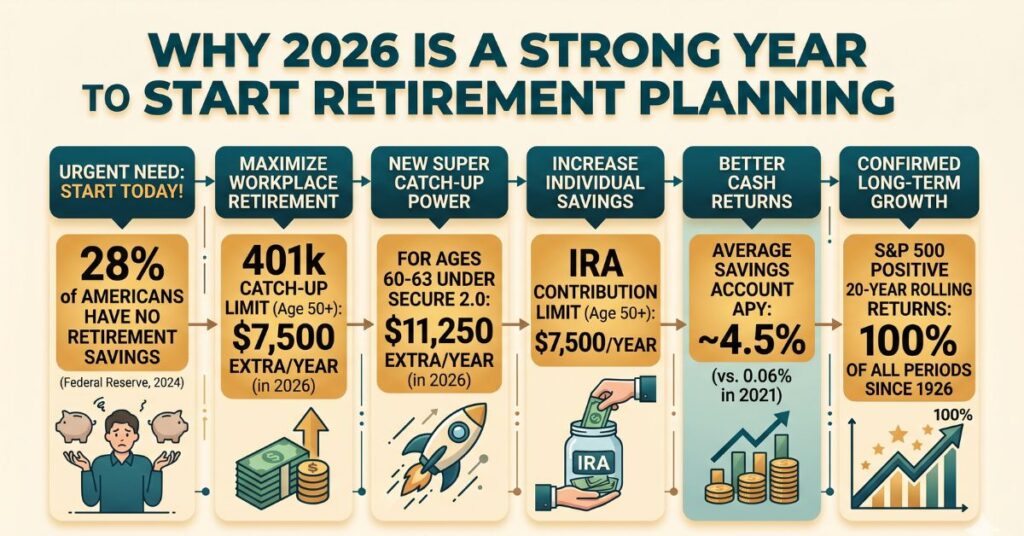
The SECURE 2.0 Act has boosted catch-up contribution limits. If you are 50 or older, you can add an extra $7,500 to your 401(k) in 2026. If you are 60 to 63, the super catch-up limit jumps to $11,250. IRA catch-up contributions sit at $7,500 for those 50 and up.
High-yield savings accounts and CDs still pay around 4.5%—far better than the near-zero rates of the 2010s. Cash actually earns something again while you build your plan.
Target-date funds and robo-advisors let anyone start with as little as $100 and get instant diversification. Free educational resources (including the ones right here on RetireWealthPath.com) have never been more plentiful or easier to access.
Despite short-term volatility, the S&P 500 has delivered positive returns over every rolling 20-year period since 1926. Time remains the single most powerful tool you have.
How to Start Today—Even If You Have $0 Saved
You do not need a huge windfall or a perfect credit score. You only need to begin.
Here is your six-step action plan you can start this week:
- Know your number—run the 4% rule calculation based on your expected monthly expenses.
- Open an account this week—even a Roth IRA with a $50 deposit creates a psychological win.
- Automate one contribution—set up a $100 monthly transfer and forget it.
- Check your 401(k) match—if your employer offers one and you are not maxing it, you are leaving free money on the table.
- Build a one-page financial snapshot—list your assets, debts, monthly income, and expenses. Most people never do this simple step.
- Schedule an annual review date—put January 1 on your calendar every year.
What If You’re Starting Late?
Yes, starting at 55 feels harder than starting at 35. But it is far from hopeless. Catch-up contributions were created exactly for people in your position. Part-time work in the early retirement years can stretch a smaller portfolio dramatically. Delaying Social Security from age 67 to 70 adds 8% per year to your benefit—an increase few investments can match.
Pro Tip: The single highest-ROI action for late starters is to delay full retirement by even two or three years. Every extra year adds savings, avoids withdrawals, and boosts Social Security benefits—all at the same time.
The Mindset Shift That Changes Everything
The practical steps matter, but the biggest barrier is usually mental. Behavioral economists call it “temporal discounting”—the future you feels less real than today’s you.
One simple fix works remarkably well: write a short letter to your 75-year-old self. Describe the life you want that person to enjoy. What kind of home, travel, time with grandchildren, or hobbies do you want? Reading that letter creates an emotional connection that makes planning feel urgent and personal.
Reframe the goal. You are not saving for some vague “retirement.” You are building a system that gives you choices—to leave a stressful job, travel, care for family, or even start a small business.
The people who succeed at retirement wealth building are not necessarily smarter or richer. They simply started. That is the only real difference.
FAQs About Why Retire Wealth Planning Starts Now
I’m 52 with almost nothing saved. Is it really not too late?
It is genuinely not too late. At 52 you still have 13+ years before traditional retirement age. Catch-up contributions, delayed Social Security claiming, and steady saving can build meaningful security. The key is starting this week, not waiting until next year.
How much should I be saving each month for retirement?
A common starting target is 15% of gross income, including any employer match. If you are starting late, aim for 20–25%. Even $200 a month invested consistently for 15 years at 7% grows to over $65,000—and that becomes a solid foundation.
What’s the difference between retire wealth planning and just saving money?
Saving money is simply putting cash aside. Retire wealth planning is a coordinated system that covers how you accumulate assets, protect them from taxes and inflation, and eventually turn them into reliable lifetime income. Saving is one ingredient—planning is the whole recipe.
Should I pay off debt before I start saving for retirement?
It depends on the interest rate. High-interest debt above 7–8% usually comes first. But always contribute at least enough to your 401(k) to capture the full employer match—that is an instant 50–100% return that beats almost any debt payoff math.
Do I really need a financial advisor to start retire wealth planning?
Not to start. Free tools at SSA.gov, IRS.gov, and investor.gov give you everything you need for the first steps. Later, when you face complex decisions around Social Security timing, tax strategy, and estate planning, a qualified advisor becomes valuable.
Ready to Become the Person Who Planned
Picture two versions of yourself at 70. One waited, worried, and hoped things would work out. The other started imperfectly, followed a simple plan, and now enjoys real choices—whether that means traveling, spoiling grandchildren, or simply sleeping without financial stress.
The three most important takeaways are simple:
- The cost of waiting is real, mathematical, and avoidable.
- Planning does not require wealth—it creates it.
- Starting imperfectly today is infinitely better than waiting for the perfect moment.
You have already taken the hardest step by reading this far. Now turn that knowledge into action. Your future self will thank you.
Disclaimer: The content on RetireWealthPath.com is for informational and educational purposes only and does not constitute financial, tax, or legal advice. We are not licensed financial advisors. The information provided may not apply to your specific situation. Always consult a qualified financial professional, tax advisor, or attorney before making any financial decisions. Retirement planning involves risk and individual results will vary.
External Links
- compound interest calculator → https://investor.gov/financial-tools-calculators → Official SEC investor education tool
- SECURE 2.0 Act catch-up contribution rules → https://www.irs.gov → IRS source for 2026 contribution limits
- Federal Reserve report on retirement savings → https://www.federalreserve.gov → Cites the 28% statistic used in the infographic