

How to Maximize Your 401k in Your 50s [2026 Guide]

Most people think their 50s are the decade they need to “catch up” on retirement savings. That framing is wrong.
Your 50s are not a catch-up decade — they are your highest-leverage decade. Higher income, lower expenses, more tax-advantaged room, and government-designed catch-up provisions all converge in these years. The question is whether you use them.
Consider the financial context most people find themselves in during their 50s: peak earning years, children leaving home and reducing household expenses, a mortgage often approaching payoff. That confluence of factors creates the single greatest wealth-building window of most people’s careers.
Here’s the math that makes the stakes real: a person who maximizes their 401k contributions from age 50 to 65 at a 7% average annual return can add $700,000 or more to their retirement balance — from contributions alone. That number does not require a higher salary, a winning stock pick, or a lucky market. It requires one form change and the discipline to leave the money alone.
This post covers seven specific, actionable strategies for how to maximize your 401k in your 50s — not general advice but concrete steps you can execute this week. Whether you’re behind and need to accelerate, or on track and need to optimize, every strategy here will move the needle.
If you haven’t yet established your specific retirement target, our retirement readiness quiz guide is the right place to start — it will give you the number your 401k strategy is actually building toward.
Let’s start with the single most powerful tool the government gives people over 50 — the catch-up contribution — because most people either don’t use it or don’t fully understand it.
Strategy 1: Master the Catch-Up Contribution (The Most Underused Tool in Your 50s)
The catch-up contribution is the most powerful — and most underused — financial tool available to people over 50. Many people know it exists. Very few understand its full scope, including the relatively new SECURE 2.0 “super catch-up” for ages 60 through 63 that dramatically expands what you can save.
What Is a Catch-Up Contribution?
The IRS allows workers aged 50 and older to contribute more than the standard annual 401k limit — a recognition that people in their 50s and 60s need an accelerated savings opportunity before retirement.
Here are the 2026 numbers:
- Standard 401k contribution limit: $23,500
- Additional catch-up contribution for age 50+: $7,500
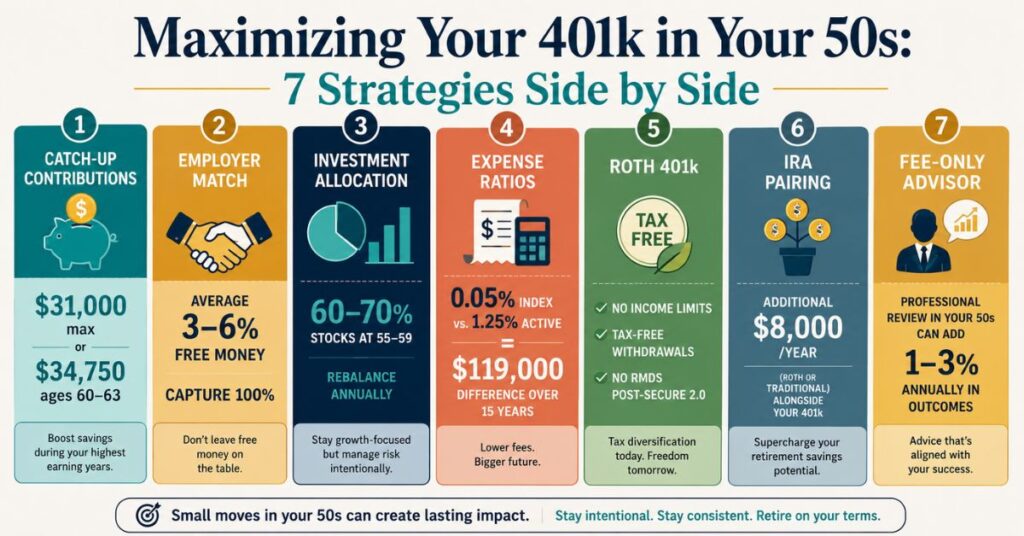
- Total maximum for age 50+: $31,000
The SECURE 2.0 Super Catch-Up for Ages 60–63
This is where it gets genuinely significant — and where most people have no idea what’s available to them.
The SECURE 2.0 Act introduced an enhanced catch-up provision specifically for workers aged 60, 61, 62, and 63. In 2026, workers in this age window can contribute an additional $11,250 above the standard limit — instead of the regular $7,500 catch-up.
That means the total maximum for ages 60–63 in 2026 is $34,750 ($23,500 + $11,250). Starting at age 64, the catch-up reverts to the standard $7,500 amount. This is one of the most significant and least-publicized retirement savings provisions introduced in recent years.
2026 401k Contribution Limits by Age
| Age Group | Standard Limit | Catch-Up Amount | Total Maximum | Roth 401k? |
|---|---|---|---|---|
| Under 50 | $23,500 | None | $23,500 | Yes — same limits |
| 50–59 | $23,500 | +$7,500 | $31,000 | Yes — same limits |
| 60–63 (SECURE 2.0) | $23,500 | +$11,250 | $34,750 | Yes — same limits |
| 64–70+ | $23,500 | +$7,500 | $31,000 | Yes — same limits |
Source: IRS retirement plan contribution limits, 2026. Limits adjusted periodically for inflation.
The Compounding Impact: Patricia’s Story
Patricia turned 50 this year and earns $95,000 as a marketing director. She has been contributing $15,000 per year to her 401k. Her HR department emails her about the new plan year. Patricia increases her contribution to the maximum $31,000 — an additional $16,000 per year. At 7% average annual return over 15 years to age 65, that additional $16,000 per year compounds to approximately $413,000 in additional retirement wealth. Patricia made one HR form change and generated $413,000.
How to Implement the Catch-Up Contribution
Log into your 401k plan’s online portal — most major providers (Fidelity, Vanguard, Schwab, Empower) allow contribution changes online in minutes. Look for a “contribution rate” or “election change” option. Set your contribution to the maximum dollar amount, or to the percentage of salary that reaches the maximum.
One important note: some plans calculate contributions as a percentage of salary. Verify that your selected percentage actually reaches the dollar maximum at your specific salary level.
If your plan offers a Roth 401k option, the same contribution limits apply — but contributions are made after tax, and qualified withdrawals are completely tax-free. Consider splitting contributions between traditional and Roth for tax diversification. More on this in Strategy 5.
Pro Tip: If you turned 50 mid-year and did not maximize catch-up contributions for the full year, you cannot retroactively contribute for the months you missed. 401k contributions are payroll-based and cannot be lump-summed after the fact like an IRA. The lesson: change your contribution election the moment you turn 50 — not at year-end when you realize you’ve lost months of maximum contributions.
Strategy 2: Capture Every Dollar of Employer Match (Free Money You Cannot Afford to Miss)
Employer matching is mathematically the highest-return investment available to any retirement saver — yet a surprising number of employees in their 50s still leave some or all of it on the table. This is not a nuanced financial trade-off. This is leaving compensation you have earned sitting uncollected.
The Mathematics of Employer Matching
The most common employer match formula: 100% match on the first 3–6% of salary contributed.
If your employer matches 100% on the first 5% and you earn $90,000, not contributing that full 5% costs you $4,500 in free compensation every year. A missed $4,500 per year in employer match from age 50 to 65, at 7% growth, represents approximately $116,000 in foregone retirement wealth. That is not a rounding error.
Finding Your Exact Match Formula
Log into your plan’s participant portal or contact HR. Look for the “employer contribution” or “matching contribution” section of your plan’s Summary Plan Description. Common formulas in 2026 include:
- Dollar-for-dollar match up to 3% of salary
- 50% match on the first 6% of salary (equivalent to 3% free money)
- Tiered match: 100% on the first 3%, 50% on the next 2%
- Safe harbor match: 100% on the first 3%, 50% on the next 2% (common in small business plans)
The Vesting Schedule Trap
Employer matching contributions may not be fully yours immediately — they may vest over a 2 to 6 year schedule.
- Cliff vesting: Zero ownership until a specific date, then 100% (example: 3-year cliff)
- Graded vesting: Gradually increasing ownership over time (example: 20% per year over 5 years)
If you are considering a job change in your 50s, the vesting schedule is a critical factor. Leaving before full vesting means forfeiting unvested matching funds. In your 50s, the dollar amounts involved in vesting forfeitures are often substantial — model the cost of leaving before vesting specifically.
Robert and Sandra: A Tale of Two Contribution Rates
Robert, 54, earns $110,000 and contributes 8% ($8,800 per year) to his 401k. His employer matches 100% on the first 6% ($6,600 per year). Robert is fully capturing the match. His colleague Sandra, same salary, only contributes 4% ($4,400). Sandra receives $4,400 in employer match — missing $2,200 per year in free money. Over 10 years at 7% growth, Sandra leaves $30,400 on the table. She makes one contribution rate change and the problem is permanently solved.
The “Match Then Max” Priority Sequence
- Contribute at least enough to capture 100% of the employer match — always priority #1
- Maximize the HSA if enrolled in a High-Deductible Health Plan — triple tax advantage
- Maximize the IRA (Roth or traditional based on your situation)
- Maximize the 401k to the full catch-up limit
- Invest in a taxable brokerage if additional savings capacity remains
Common Mistake: Prioritizing a maxed Roth IRA before capturing the full employer 401k match. A Roth IRA’s tax-free growth is valuable — but a 100% immediate return from an employer match cannot be beaten. Always capture the full match before directing any savings dollars elsewhere.
Strategy 3: Optimize Your 401k Investment Allocation for Your 50s
Investment allocation is the area where 50-something 401k savers make the most persistent mistakes — typically either too conservative (leaving growth on the table) or too aggressive (exposing themselves to devastating sequence-of-returns risk). Neither extreme serves you.
Your 50s are the decade when your portfolio transitions from pure accumulation to pre-distribution optimization. The years immediately before and after retirement carry the highest sequence-of-returns risk — a major market decline in this window can permanently impair retirement security. At the same time, with 15 to 25 years of retirement ahead, you need continued growth to outpace inflation. Excessive conservatism is its own risk.
The Allocation Framework for Your 50s
Early 50s (50–54): Still 10–15 years from likely retirement — can sustain higher equity exposure. Suggested range: 70–80% stocks / 20–30% bonds and alternatives.
Mid 50s (55–59): Beginning the transition phase — 5–10 years from retirement. Suggested range: 60–70% stocks / 30–40% bonds and alternatives. Begin building a cash or short-term bond buffer representing 1–2 years of retirement expenses.
Early 60s (60–64): Approaching retirement — 1–5 years out. Suggested range: 50–60% stocks / 40–50% bonds and cash. Sequence-of-returns risk management becomes critical — protect the first 3–5 years of withdrawals.
Why You Should Not Go to 100% Bonds or Stable Value
A portfolio that earns 3–4% in bonds while inflation runs 2.5–3% leaves only 0.5–1.5% in real return. The real purchasing power erosion over 25 years at those returns is severe. Modern retirement planning recommends maintaining 40–60% equity exposure throughout retirement, not just until retirement.
Dennis’s Costly Mistake
Dennis, 57, has his entire 401k in his company’s stable value fund — yielding 3.5%. He switched to stable value in 2022 when the market dropped and has not changed it. With 8 years until retirement at 65 and a 25-year retirement horizon ahead, Dennis’s portfolio earning 3.5% is barely keeping pace with inflation. At 7% average stock market returns, Dennis’s $450,000 portfolio would grow to approximately $770,000 by 65. At 3.5%, it grows to only $605,000. Dennis’s excessive caution costs him $165,000 — before accounting for inflation erosion of the stable value returns.
The Target-Date Fund Solution
If building a custom allocation feels overwhelming, a target-date fund (such as Vanguard Target Retirement 2030 or Fidelity Freedom 2030) handles the allocation automatically and adjusts toward more conservative holdings as the target date approaches. Target-date funds are not perfect — they vary in glide path aggressiveness by provider — but they prevent the two most common allocation mistakes: being too aggressive at retirement and being too conservative too early.
Check the expense ratio. A target-date fund charging 0.10–0.15% (like Vanguard’s) is excellent. One charging 0.80–1.0% is not justified given passive index alternatives.
The Rebalancing Imperative
Rebalance annually — or when any asset class drifts more than 5% from its target. Use new contributions to rebalance rather than selling, as this reduces tax friction in taxable accounts (though it’s irrelevant inside a 401k). Many plans offer automatic rebalancing — turn it on.
Pro Tip: Log into your 401k portal today and check when your allocation was last changed. If the answer is “never” or “when I first enrolled,” your allocation almost certainly no longer reflects your current age, risk tolerance, or proximity to retirement. A 30-minute portfolio review — adjusting fund selections and enabling automatic rebalancing — is one of the most impactful actions you can take this week.
Strategy 4: Reduce Investment Costs Ruthlessly (The Silent Retirement Killer)
Investment fees inside a 401k are the most underappreciated destroyer of retirement wealth — working silently against the saver every single day for decades. Most people never look at them. Most people pay a significant and entirely avoidable tax on their own savings as a result.
How Expense Ratios Compound Against You
An expense ratio is the annual fee a fund charges, expressed as a percentage of assets.
- A 1.0% expense ratio on a $300,000 portfolio costs $3,000 per year
- A 0.05% expense ratio on the same portfolio costs $150 per year
- The difference: $2,850 per year — growing every year as the portfolio grows
What High Fees Cost You Over 15 Years
Assume a $300,000 starting balance, no additional contributions, and a 7% gross return over 15 years:
| Expense Ratio | Net Return | Portfolio Value at Year 15 | Lost to Fees |
|---|---|---|---|
| 0.05% (index fund) | 6.95% | $826,000 | $11,000 |
| 0.25% (low-cost active) | 6.75% | $806,000 | $31,000 |
| 0.75% (average active) | 6.25% | $762,000 | $75,000 |
| 1.25% (high-cost active) | 5.75% | $718,000 | $119,000 |
| 1.75% (insurance products) | 5.25% | $676,000 | $161,000 |
Illustrative calculations based on compound growth at specified net returns. For educational purposes only.
The difference between a 0.05% index fund and a 1.25% actively managed fund is $119,000 — on a portfolio that never receives another dollar of contributions. That is not a theoretical number. It is money that goes to the fund company instead of your retirement account.
How to Find and Fix Your Fund Costs
Log into your 401k portal — most show expense ratios in the fund information section. Alternatively, search the fund name plus “expense ratio” on Morningstar. Then compare each fund you hold to its low-cost index alternative.
What to look for: S&P 500 index funds or total market index funds typically carry 0.01–0.15% expense ratios. Bond index funds typically run 0.03–0.15%. Actively managed funds rarely outperform their index equivalents after fees — decades of data support this.
If your plan offers only high-cost options, choose the lowest-cost funds available within the plan. Maximize the 401k enough to capture the employer match, then direct additional savings to an IRA where you control the investment options and can access ultra-low-cost index funds from Vanguard, Fidelity, or Schwab.
You can also file a formal complaint with HR. ERISA fiduciary duty regulations require plan sponsors to offer reasonably priced investment options. Employee pressure has successfully changed fund lineups at many companies.
Common Mistake: Holding variable annuity products inside a 401k. Some older 401k plans contain variable annuities with annual charges of 1.5–2.5% — dramatically above index fund alternatives. If your plan contains annuity products, ask HR whether lower-cost alternatives exist and evaluate rolling the funds to a low-cost IRA if you leave the employer.
Understanding the retirement planning vocabulary behind terms like expense ratio, fiduciary duty, and ERISA will help you have a more productive conversation with your plan administrator when advocating for better options.
Strategy 5: Use the Roth 401k Option for Tax Diversification
The Roth 401k is one of the most underutilized options in the American retirement system — available at many employers but chosen by relatively few employees. In your 50s, the tax diversification it provides can be genuinely transformative.
What Is a Roth 401k?
A Roth 401k combines the contribution limits of a traditional 401k (much higher than a Roth IRA) with the tax treatment of a Roth IRA (after-tax contributions, completely tax-free qualified withdrawals).
Key facts:
- Same contribution limits as a traditional 401k: up to $31,000 in 2026 for age 50+ (or $34,750 for ages 60–63)
- No income limits — high earners phased out of Roth IRA contributions can still use the Roth 401k
- Qualified withdrawals — principal and all growth — are completely tax-free
- Under SECURE 2.0 (effective 2024), Roth 401k funds are no longer subject to RMDs — matching Roth IRA treatment
Why the Roth 401k Matters Especially in Your 50s
Many people in their 50s have accumulated large pre-tax 401k and IRA balances. At age 73, Required Minimum Distributions force withdrawals from those pre-tax accounts — potentially pushing retirees into higher tax brackets and triggering Medicare IRMAA surcharges.
Contributing to a Roth 401k in your 50s builds the tax-free bucket that gives you flexibility to manage taxable income in retirement. It also creates a hedge: if tax rates rise in the future, your Roth balance is completely insulated.
The Tax Rate Calculation
Roth contributions make sense when you expect your tax rate in retirement to be equal to or higher than your current rate. In your 50s at peak earnings, you may be in the 22%, 24%, or 32% federal bracket. In retirement with strategic withdrawal management, some people can stay in the 12% or 22% bracket — which would make traditional contributions more advantageous.
The answer depends on your specific income projection. But for high earners building large pre-tax balances, some Roth 401k contribution is almost always appropriate. You don’t have to choose between 100% traditional or 100% Roth — a 50/50 split provides tax diversification without over-committing to either direction.
Karen’s Pre-Tax Problem — and the Solution
Karen, 56, earns $145,000 and is in the 24% federal bracket. Her 401k balance is $480,000 — all in traditional pre-tax funds. She contributes $31,000 per year. At her projected retirement at 67, her RMDs starting at 73 will be substantial — potentially pushing her into the 22% or 24% bracket in retirement on top of Social Security and investment income.
Karen switches to a 50/50 Roth/traditional split: $15,500 traditional (current tax deduction), $15,500 Roth (future tax-free). Over 11 years at 7% return, Karen’s Roth balance grows to approximately $245,000 of completely tax-free money — meaningfully reducing her pre-tax RMD exposure.
Strategy 6: Open and Maximize an IRA Alongside Your 401k
Many people in their 50s treat the 401k as their only retirement savings vehicle — not realizing that an IRA can run simultaneously and provide additional tax-advantaged savings, broader investment choice, and powerful Roth conversion opportunities.
IRA Limits in 2026
- Traditional or Roth IRA standard limit: $7,000 per year
- Age 50+ catch-up: additional $1,000
- Total IRA maximum for age 50+: $8,000 per year
Roth IRA income limits in 2026:
- Single filers: phase-out begins at $150,000, eliminated at $165,000
- Married filing jointly: phase-out begins at $236,000, eliminated at $246,000
Can You Contribute to Both a 401k AND an IRA in the Same Year?
Yes — completely independently. You can max both simultaneously:
- Ages 50–59: $31,000 (401k) + $8,000 (IRA) = $39,000 in total annual tax-advantaged contributions
- Ages 60–63: $34,750 + $8,000 = $42,750
The Backdoor Roth IRA for High Earners
High earners above the Roth IRA income limits can still access Roth benefits through the backdoor Roth IRA strategy:
- Contribute to a traditional IRA (non-deductible, after-tax)
- Convert the non-deductible traditional IRA to a Roth IRA
The converted amount is not taxed — it was already after-tax money — provided no pre-tax IRA balances exist (the pro-rata rule complicates this if pre-tax IRAs are present). The backdoor Roth is a legal, widely used strategy specifically appropriate for high earners in their 50s.
Michael’s Hidden Savings Opportunity
Michael, 52, earns $175,000 and maxes his 401k at $31,000 per year. He has been unaware that he can also contribute to an IRA. His MAGI of $175,000 exceeds the Roth IRA income limit, so his CPA walks him through the backdoor Roth: Michael contributes $8,000 to a non-deductible traditional IRA, then converts it to Roth — paying no tax since it was already after-tax money and he has no other traditional IRA balances. Over 13 years to age 65 at 7% return, Michael’s backdoor Roth grows to approximately $155,000 of completely tax-free money — available without RMDs, without taxes, for life.
The IRA Investment Flexibility Advantage
A 401k limits your investment choices to the funds offered by the plan. An IRA held at Fidelity, Vanguard, or Schwab gives you access to virtually any investment — individual stocks, ETFs, index funds, REITs, bonds — with expense ratios as low as 0.03%. For savers whose 401k offers limited or high-cost fund options, the IRA provides an escape valve for lower-cost investing.
Pro Tip: The $8,000 IRA limit is per person. A married couple can each contribute $8,000 per year for a combined $16,000 in additional annual IRA savings. Even a non-working spouse can contribute to a Spousal IRA if the working spouse has sufficient earned income — doubling the couple’s IRA savings capacity at no additional employment requirement.
Strategy 7: Address the Investment Performance Leaks in Your 401k
Beyond contributions and allocation, several specific 401k behaviors — often invisible to the saver — silently destroy performance. Identifying and closing these leaks can be as valuable as increasing contributions.
Leak 1: Company Stock Concentration Risk
Many 401k participants hold a disproportionate amount of company stock — sometimes 20–50% of their portfolio. This creates catastrophic concentration risk: if your employer struggles financially, both your job AND your retirement savings are at risk simultaneously. The failures of Enron in 2001 and Lehman Brothers in 2008 wiped out the retirement savings of thousands of employees who had concentrated holdings in company stock.
Rule of thumb: company stock should represent no more than 5–10% of your 401k portfolio — regardless of how confident you feel in your employer. If you have significant company stock, create a systematic plan to diversify into index funds over 12–24 months.
Leak 2: The 401k Loan Trap
401k loans may feel convenient — you’re “borrowing from yourself” — but they carry serious hidden costs. Borrowed funds are removed from the market, missing any growth while the loan is outstanding. Loan repayments are made with after-tax dollars, then withdrawals in retirement are taxed again — creating effective double taxation. And if you leave your employer while a loan is outstanding, the entire remaining balance may become due immediately — becoming a taxable distribution (plus 10% early withdrawal penalty if under 59½) if not repaid.
In your 50s, 401k loans are particularly costly. You are in your highest-leverage accumulation years and cannot afford to have capital sitting outside the market.
Leak 3: Automatic Escalation That Stopped
Many plans offer automatic contribution escalation — increasing your contribution percentage by 1% each year automatically. Many participants set this up, forget about it, and then fail to notice when it stopped at a plan-defined cap (often 10–15%). Check your escalation status: if automatic escalation has stopped, resume it manually and verify that catch-up contribution space is being utilized.
Leak 4: The Mega Backdoor Roth Opportunity
Some 401k plans allow after-tax contributions beyond the standard employee limit. The total plan limit in 2026 (employee + employer + after-tax) is $70,000 (or $77,500 for age 50+).
If your plan allows after-tax contributions AND in-service withdrawals or in-plan Roth conversions, you can contribute after-tax dollars and convert them to Roth — the Mega Backdoor Roth. Not all plans allow this, but for high earners in their 50s who have maxed all other accounts, the Mega Backdoor Roth can add $30,000–$40,000 per year in Roth savings capacity. Check your Summary Plan Description for “after-tax contributions” and “in-service withdrawal” provisions.
Leak 5: Not Reviewing the Plan After Employer Changes
Mergers, acquisitions, and plan administrator changes frequently result in 401k fund lineup changes. Many participants are unaware when their fund choices change — continuing to hold a discontinued fund or a higher-cost replacement. Review your 401k fund lineup every 6–12 months, especially if your employer has undergone any ownership or administrative changes.
Common Mistake: Taking a 401k loan in your 50s to fund home renovations, a child’s education, or credit card debt payoff. While 401k loans feel like a no-cost solution, the market participation loss during the loan period, the double taxation on repayments, and the default risk if you change jobs can easily cost more than a home equity loan — especially in your highest-compounding pre-retirement decade.
The 50s 401k Maximization Checklist: 15 Actions to Take This Month
Reading is not doing. This checklist converts every strategy above into a concrete, time-bound action sequence. Work through it this month.
This Week (30 Minutes or Less Each)
- [ ] Log into your 401k portal and verify your current contribution amount and percentage
- [ ] Check whether you are at the maximum: $31,000 (ages 50–59) or $34,750 (ages 60–63) in 2026
- [ ] If not at the maximum: increase your contribution rate today — do not wait for a “good time”
- [ ] Verify you are capturing 100% of the employer match — check the match formula in plan documents or with HR
- [ ] Check your current investment allocation — compare to the age-appropriate ranges in Strategy 3 above
This Month
- [ ] Review every fund’s expense ratio — identify any fund above 0.50% and research lower-cost alternatives in your plan’s fund menu
- [ ] Check for company stock concentration — if it exceeds 10% of your portfolio, create a diversification plan
- [ ] Verify whether your plan offers a Roth 401k option — if yes, evaluate whether splitting contributions between traditional and Roth makes sense for your tax situation
- [ ] Check for the after-tax contribution option (Mega Backdoor Roth) in your plan documents
- [ ] If you have an outstanding 401k loan, create an accelerated repayment plan
This Quarter
- [ ] Open an IRA (Roth or traditional/backdoor Roth based on your income) at Fidelity, Vanguard, or Schwab — set up a monthly automatic contribution of $666/month ($8,000/year)
- [ ] Schedule an annual portfolio review reminder in your calendar every January
- [ ] Request your plan’s Summary Plan Description (SPD) from HR — read the sections on investment options, after-tax contributions, and in-service withdrawals
- [ ] If your plan’s fund lineup is limited or high-cost, send a formal written inquiry to HR requesting lower-cost index fund options
- [ ] Consider scheduling a one-time consultation with a fee-only financial advisor — particularly if you are within 10 years of your target retirement date
Frequently Asked Questions
I’m 52 and have only $80,000 saved in my 401k. Is it too late to retire comfortably?
It is not too late — but it requires deliberate, aggressive action in the next 13–15 years. At $80,000 with 13 years of maximum catch-up contributions ($31,000/year) at 7% average returns, your balance can grow to approximately $730,000. Add Social Security income and any other savings, and a modest but genuine retirement is achievable. The critical step is maximizing contributions immediately — every year at reduced contributions is compounding opportunity lost permanently. Use the retirement readiness quiz to map your specific number.
Should I stop contributing to my 401k to pay off my mortgage before retirement?
It depends on the interest rate comparison. If your mortgage rate is 3–4%, the long-term expected return of your 401k investments significantly exceeds the cost of carrying the mortgage — meaning continued contributions likely produce better outcomes. If your mortgage rate is 6–7% or higher, the math is closer. However, always prioritize capturing your full employer match before any mortgage paydown — the match represents a 50–100% immediate return that no mortgage payoff can compete with.
My 401k plan at work is terrible — high fees and limited options. What should I do?
First, contribute at least enough to capture the full employer match — even in a bad plan, free matching money is almost always worth the high-fee drawback. Then, direct additional retirement savings to an IRA at Fidelity, Vanguard, or Schwab where you can access ultra-low-cost index funds. Simultaneously, formally request that HR improve the fund lineup — ERISA fiduciary duty regulations require plan sponsors to offer reasonably priced options, and employee pressure has successfully prompted plan improvements at many companies.
Can I contribute to a 401k and a SEP IRA in the same year?
It depends on your employment situation. If you have W-2 income from an employer and also have self-employment income from consulting, freelancing, or a side business, you can contribute to both your employer’s 401k and a SEP IRA for your self-employment income. The limits are calculated separately, and combining them can result in very high total annual contributions — one of the most powerful retirement savings strategies available to employees with side income, and one that is significantly underused in your 50s.
What happens to my 401k if I leave my job in my 50s?
You have four options: leave it in your former employer’s plan (if they allow it), roll it to your new employer’s plan, roll it to an IRA, or cash it out. Cashing out triggers full income tax plus a 10% early withdrawal penalty if you are under 59½ — almost always the worst option. The IRA rollover is typically the most flexible choice. One important exception: the “Rule of 55” allows penalty-free withdrawals from a 401k at a former employer if you separated from service at age 55 or older. This option disappears if you roll to an IRA.
Putting It All Together
Return to the opening reframe: your 50s are not a catch-up decade. They are the highest-leverage decade in any working person’s financial life. The math does not forgive waiting, but it rewards action with remarkable force.
Three takeaways worth carrying into every financial decision you make from this point forward:
First, catch-up contributions — especially the SECURE 2.0 super catch-up for ages 60–63 — are the single most powerful government-provided tool available to you right now. They are criminally underused. Log into your 401k portal today.
Second, investment costs are silent destroyers of retirement wealth. Switching from 1.0% to 0.05% expense ratios on a $400,000 portfolio saves approximately $3,800 per year — compounding for 15 years. You can make this change in 20 minutes without leaving the plan you’re already in.
Third, the Roth 401k and IRA combination creates the tax diversification that gives you maximum flexibility to manage retirement income taxes for the rest of your life. Start building the tax-free bucket now, not later. Once you’ve connected your 401k strategy to a specific retirement target, the how to set your retirement number guide will help you see exactly where you stand and what you’re building toward.
The decade between 50 and 60 will never come again. The decisions you make with your 401k in these years will shape every year that follows. Make them count.
Disclaimer: The content on RetireWealthPath.com is for informational and educational purposes only and does not constitute financial, tax, or legal advice. We are not licensed financial advisors. The 401k contribution limits, catch-up contribution amounts, SECURE 2.0 provisions, Roth 401k rules, IRA limits, income thresholds, and all other figures referenced in this article reflect 2026 IRS guidelines and are subject to change by legislation or IRS policy. All calculations, named examples, portfolio projections, and strategy recommendations — including Patricia, Robert, Sandra, Dennis, Karen, and Michael — are for illustrative and educational purposes only and do not represent guaranteed outcomes. Investment returns are not guaranteed — historical averages are provided for illustrative purposes only and future returns may differ significantly. Always consult a qualified financial professional, tax advisor, or retirement planning specialist before making contribution, investment allocation, or account strategy decisions.